The short answer
Use workflow automation when the steps and rules are known. Consider an AI agent when the task needs flexible interpretation or a changing sequence of actions. Many business processes work best with a fixed workflow containing a small, reviewable AI step.
The difference is who chooses the next step
A workflow follows a path defined in advance. When a form arrives, validate its fields, create a record and notify the right person. An agent can choose actions as it works toward a goal, using the information it encounters. That flexibility can help with uncertain tasks, but it creates more behavior to evaluate and control.
Anthropic’s architectural guidance distinguishes predefined workflows from agents that dynamically direct their own processes and tool use. Terminology varies between products, so ask a supplier to show the actual decision path rather than rely on the label ‘agent’.
Compare approaches using the same business problem
Consider an illustrative order-processing task. An order from a standard form can be validated and copied into the order system by a conventional integration. Adding an agent to choose which fields go where may introduce uncertainty without improving the outcome.
An order arriving as a free-form email is different. An AI step could extract a proposed product, quantity and delivery date. Fixed code can validate those values against the product catalog, while an employee approves ambiguous orders. The whole process does not need to become autonomous because one step benefits from interpretation.
| Task | Sensible starting point | Key control |
|---|---|---|
| Copy validated form fields | Fixed integration | Field validation and duplicate prevention |
| Interpret an incoming email | AI extraction within a workflow | Source evidence and review of uncertain fields |
| Investigate an unfamiliar support issue | Bounded agent | Restricted tools, time limits and escalation |
| Approve a refund or release funds | Explicit business rules and human approval where required | Authority checks and a recorded decision |
Why flexibility has a cost
An agent may need several model calls and tool interactions to finish one task. That means variable running cost and response time. A wrong intermediate interpretation can affect later actions. You need to observe the sequence, not just the final answer.
For a process owner, the important questions are practical: can the agent alter a customer record, send a message or spend money? What stops repeated attempts? Can a person see why an action was proposed? Define these limits before giving it production access.
Design human approval around consequences
Human review is useful when the reviewer has enough information to make a real decision. Show the original request, proposed action, supporting evidence and relevant exceptions. A single ‘approve’ button attached to an unexplained recommendation creates the appearance of control without much ability to exercise it.
Start with read-only access or draft outputs where possible. Measure corrections and failures on representative work. Expand the permitted actions only when the evidence justifies it. Some tasks should remain under direct human control even if an agent can technically perform them.
A short decision checklist
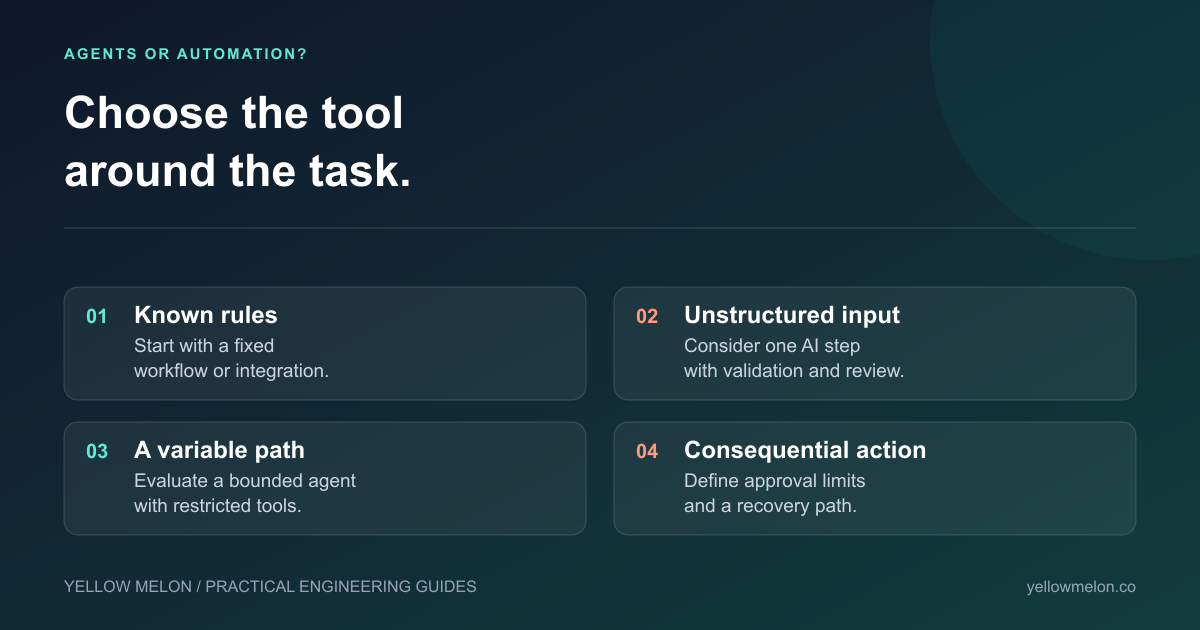
Map one workflow before choosing software. Identify the inputs, known rules, exceptional cases and actions whose consequences matter. Then choose the least complex approach that meets those requirements.
- Are the inputs structured and the next steps known? Start with conventional automation.
- Does one step need interpretation? Test an AI step inside a controlled workflow.
- Does the path genuinely vary? Evaluate a bounded agent against realistic examples.
- Is a wrong action costly or difficult to reverse? Design approval and recovery first.
Sources & further reading

About James Drummond
Founder of Yellow Melon and senior full-stack developer. James built and sold Smoothbook and has worked on systems for Universal Music Group, AllSaints and financial-services businesses.
Professional background →